|
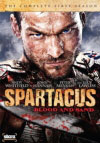
SPARTACUS: BLOOD AND SAND, Season One (2010)
This is an astonishing tour de force of storytelling. The outrageous gore and demeaning sex may seem gratuitous at first, mere titillation; but then, around episode 4, a narrative of almost demonic intensity kicks in, and hurtles toward a stunning climax. We are made not only to understand but to feel how a slave state poisons and demeans every human interaction, and how the unthinkable can become the inevitable—like a cosmic event, the uprising of Spartacus must happen.
The conviction of the filmmakers is absolute; it’s like they’re painting the Sistine Chapel. Yet, in an earlier age, this material would certainly have been prosecuted for obscenity. You feel a bit guilty watching SPARTACUS because you should feel guilty. But there is no other way to truly tell this story. As Dave Kehr of the NY Times wrote about another daring “shocker” (MANDINGO, set in the Old South): “When the historical context is itself obscene, transgressions are justified.”
As the scheming, social-climbing dominus and domina of the House of Batiatus, John Hannah and Lucy Lawless deliver the performances of a lifetime. They are more than matched by the late Andy Whitfield in the title role. Will SPARTACUS survive without him? Whatever happens with the rest of this series, Season One is a magnificent accomplishment.
|
|
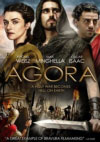
AGORA (2009)
Rachel Weitz stars as Hypatia, the scientist-scholar who ran afoul of the Christians amid the turbulent death-throes of paganism at the end of the 4th century A.D. Directed by Alejandro Amenábar (THE OTHERS, THE SEA INSIDE), the film features an extraordinary recreation of Alexandria—this may be the most meticulously crafted vision of the Ancient World ever put on screen. AGORA is a visually haunting film, one of the most beautiful I’ve ever seen.
AGORA was a huge hit across Europe, but received only very limited release in the U.S., perhaps because distributors feared its depiction of ascendant Christianity would be inflammatory. (You can find plenty of religious bloggers online “debunking” the movie, even while some of them proudly proclaim they never saw it—ironically validating Amenábar’s point about the pernicious blindness of those who follow dogma, rather than the rational pursuit of truth.) In the long cycle of Ancient World movies kicked off by GLADIATOR, we’ve endured so many bad films—ostensibly set in the Ancient World, but made by people who don’t give a damn about history or myth and just want to deliver a Hollywood formula (and can’t even do that competently)—and when we’re finally rewarded with a work of consummate artistry and integrity like AGORA, it’s rolled out with zero fanfare.
For all its violence, the film is extremely subtle and sophisticated. I was reminded of the highbrow costume dramas that were Oscar-bait when I was young, movies like BECKET and A MAN FOR ALL SEASONS, stories about men of conscience struggling to maintain their self-respect and stay alive surrounded by treachery and hypocrisy. In this case, the story is not about a man, but a woman for all seasons, Hypatia.
AGORA is a film of profound ideas, beautifully told. A myriad of small details add up to a powerfully authentic historical and human vision. I am thinking of the indulgent yet ultimately callous way that Hypatia treats her starry-eyed slave Davus, which leads to his “radicalization”; the way we are shown that the Christians won hearts and minds by providing superior social services to the populace; the far-from-innocent role played by the pagans and the Jews in the series of violent clashes with the Christians; the beautiful scene where Orestes plays the pipes in the theater and the camera rises to a cosmic viewpoint; the moonlit discussion of Aristarchus’s “outmoded” idea of a heliocentric universe.
A small but telling visual detail: in their prime, many of the pagan statues would have been brightly painted. We see them very faded, with only traces of color remaining. The exterior statues are more faded than the interior ones. Obviously, the pagans have fallen on hard times and are no longer keeping the statues the way they used to—a very subtle but striking visual device that reveals, literally and metaphorically, the fading power of the old religion and its followers.
|
 |
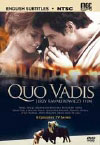
QUO VADIS (2001)
Nobel Prize winner Henryk Sienkiewicz is Poland’s most revered author; this 2001 adaptation of his world-famous novel is the most expensive movie in Polish history. It’s lavish, to be sure, but its real impact comes from the power of its storytelling and the timelessness of its themes.
Sienkiewicz was a devout Catholic, and writer/director Jerzy Kawalerowicz’s intent is undoubtedly pious — one viewer called QUO VADIS a cross between a Catholic mass and I, CLAUDIUS — but to me, the Christian point of view neither diminishes nor enhances the basic integrity of the story, which is about human beings caught in the maelstrom of Nero’s reign. Some, like the pagan Petronius, tread the razor’s edge, as must all artists and intellectuals who live under an autocrat (Eisenstein under Stalin comes to mind). Others, like Vinicius and his beloved Lygia, happen to be members of the particular cult which Nero chooses to scapegoat after a fire ravages Rome and destabilizes his regime. This is a tragedy repeated throughout history: when a catastrophe strikes, like the burning of Rome — or the attack on the World Trade Center — the scapegoating impulse of the populace will be exploited by evil men to bring about the death and suffering of innocent people. Whether Christians are the victims or the perpetrators of such scapegoating, it is the duty of history and of art to record the suffering of the innocent — which QUO VADIS achieves, hauntingly and brilliantly.
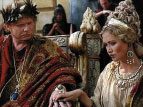
Michal Bajor as Nero surpasses all other screen incarnations of the deranged emperor. Boguslaw Linda plays Petronius, the shrewd survivor, with the multi-layered subtlety the role demands. The other characters are equally well cast, from Judo world champion Rafal Kubacki’s towering Ursus to Agnieszka Wagner’s blood-chilling Poppaea. Special kudos to Jerzy Trela in the tragicomic role of Chilo Chilonides.
Although QUO VADIS was edited for theatrical release, it’s the original 6-part TV series that’s available on DVD with English subtitles. The pace never flags and the sprawling novel is well suited to serial format.
|
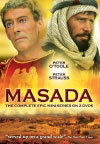 |
MASADA (1981)
The subject of this 6-hour miniseries is the Roman siege of the mountaintop fortress of Masada in Judaea in 72 A.D., where a band of Zealots made a last stand against Roman authority. Peter O’Toole plays the world-weary Roman commander, Flavius Silva, a man torn between political expediency and personal decency; from his amazing first scene to the last, O’Toole delivers perhaps the finest performance of his career. Peter Strauss plays an equally challenging role; is the insurgent leader Eleazar ben Yair a visionary freedom fighter, or the ancient equivalent of a suicide bomber — or both?
The script, based on Ernest K. Gann’s novel The Antagonists, follows the account of the historian Josephus but intelligently embellishes the story and characters to offer keen insights into religion, politics, military discipline and the psychology of war. The scale is epic, but the focus is intimate, drawing us into the tragic battle of wills and wits between two charismatic and very human leaders.
The action scenes and the lighting sometimes remind us that this is a TV miniseries from 1981, but these limitations are more than made up for by the quality of the costumes and sets (including siege engines) and the fact that MASADA was filmed on location. The tone of a brief prologue and epilogue about the place of Masada in modern Israel also dates the movie, but adds another layer of history to a tale that seems remarkably timely now, as once again a superpower embroiled in the Middle East faces a relentless desert insurgency against its military occupation. Many of the issues evoked by MASADA are in play today; only the players are different.
|
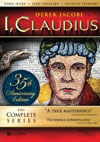 |
I, CLAUDIUS (1976)
It’s been years since I’ve rewatched this classic BBC television series (a sprawling, 11-hour adaptation of the famed novel by Robert Graves). First broadcast in 1976, it made an enormous impression on me during my college days at UT Austin, where I majored in History and dabbled in Classics.
Production standards were modest, but writing and performances were top-notch. Derek Jacobi as the stuttering Claudius, Patrick Stewart as the cold-blooded Sejanus, John Hurt as the mad Caligula, Siân Phillips as the scheming Livia, and Brian Blessed as the long-suffering Augustus (“Is there any man in Rome who has not slept with my daughter?”) all made indelible impressions on my psyche. Imperial intrigue consumes the first family of Rome in an ever-widening vortex of power-madness and paranoia.
The 35th Anniversary DVD set features lots of extras, including “The Epic That Never Was,” a documentary about the previous, failed attempt in 1937 to film the novel with Charles Laughton as Claudius.
|
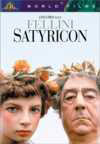 |
FELLINI SATYRICON (1969)
It’s been a few years since I watched this totally idiosyncratic work of genius, but Fellini’s vision of ancient Rome is unforgettable. Working from the erotic novel by Petronius (Nero’s arbiter of taste), inspired by previous cinematic incarnations of Rome, and informed by his lifelong love of the Eternal City, Fellini crafted a movie like no other.
The result is uneven, to be sure (like all the master’s movies), but the world would be a poorer place if this film had never been made. Moments of breathtaking beauty contrast with images of appalling horror; love, lust, madness, and laughter crowd the teeming screen; and in the end, the will of the gods remains obscure. As the promo ads promised when the film was released, this is “Rome — Before Christ, After Fellini!”
|
|
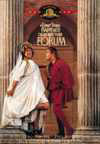
A FUNNY THING HAPPENED
ON THE WAY TO THE FORUM (1966)
The Romans loved comedy, but their sense of humor often eludes us. How to bridge the cultural gap? Re-imagine the comedies of Roman playwright Plautus through the filters of vaudeville schtick and the Broadway musical! Stephen Sondheim wrote the songs. Zero Mostel stars as Pseudolous, the clever slave, with Jack Gilford, Phil Silvers, Michael Hordern, and Buster Keaton along for this wild chariot ride of a movie.
This was the first time ancient Rome was shown on screen as a dirty, cluttered, thriving, real city, instead of a white marble wedding cake. Filming in Spain, director Richard Lester invited local peasants to live and work in the rustic sets, and allowed fruits and vegetables to rot, just to achieve the right atmosphere.
|
|
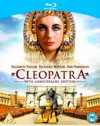
CLEOPATRA (1963)
I can’t claim to be objective about this movie. I couldn’t wait to see it as a boy, and once I did, I was never the same; the story of Caesar, Cleopatra, and Marc Antony became one of the central myths of my life. For me, to watch this film is to enter a realm of dreams; I am transported to the harbor at Alexandria, to Cleopatra’s mind-boggling arrival in Rome, to her over-the-top reception of Marc Antony on her barge, and on to their disastrous naval defeat at Actium. I witness the Queen’s final moment on earth, when she submits to the bite of the asp and attains immortality.
Filmmaker Joseph Mankiewicz intelligently adapted the ancient sources with an ear for sophisticated dialogue. This was the man who gave us both JULIUS CAESAR with Marlon Brando and ALL ABOUT EVE with Bette Davis; here his intimate understanding of power, wealth, and sophistication all come together to render a memorable portrait of a woman whose name is still a household word two thousand years after her death.
|
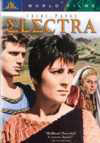 |
ELECTRA (1962)
When the victor of the Trojan War, King Agamemnon, is murdered, must his children avenge him — even if it means killing their own mother? Working in primal black and white, with a Greek-speaking cast headed by the great Irene Papas, director Michael Cacoyannis (ZORBA THE GREEK) sets a deliberate pace that builds to a powerful climax. The music score by Mikis Theodorikis is mesmerizing, full of raw emotion and strange beauty, a perfect counterpart to the stark visuals and powerful performances.
Roger Ebert calls ELECTRA “the best film ever made from a Greek tragedy.” I tend to agree, but Cacoyannis made two other films based on Greek tragedies, and all three are remarkable. In IPHIGENIA, the Greeks are unable to sail to Troy because of a windless sea, and their leader, Agamemnon, decides to make a terrible sacrifice. In THE TROJAN WOMEN, an all-star cast — Vanessa Redgrave as Andromache, Katherine Hepburn as Hecuba, Genevieve Bujold as Cassandra, Irene Papas as Helen — captures the tragic fate of the female survivors after the fall of Troy.
|
|
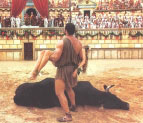
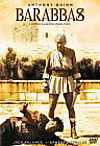
BARABBAS (1961)
The convict freed in place of Jesus becomes a gladiator in Rome. The subject is Christian faith, but the story is deliberately constructed so that the existence of the Jews’ god and the miraculous resurrection of Jesus are never affirmed; all we see for certain is the harsh world in which Barabbas lives. The great Anthony Quinn delivers a powerful performance as the man who moves through life with a taciturn, beast-like acceptance of his circumstances, which take him from Jerusalem to a mine in Sicily to Nero’s Rome.
Underrated Hollywood director Richard Fleisher (THE VIKINGS, MANDINGO) creates an entirely convincing portrait of the grimy ancient world; the truly spectacular scenes of gladiator combat in the arena are probably the best ever filmed. (Jack Palance as the terrifying Torvald is the stuff of nightmares!) A remarkable atmosphere is created by the muddy color palette of the cinematography and a sometimes eerie musical score, and the story leaves the viewer (Christian or not) with much to contemplate. Based on the novel by Nobel Prize winner Pär Lagerkvist.
|